Where is this baseline noise coming from?
Before you order a new lamp, stop the flow for ten minutes. Whether the noise stays or goes tells you which half of the instrument to open.

| What you see | Likely causes | Check first |
|---|---|---|
| Regular noise in step with the pump stroke (HPLC) | Pump pulsation, a leaking check valve Reference [1] Reference [2] | Pressure trace, check valves |
| Wavy baseline in a TFA gradient at low UV (HPLC) | Solvents not fully mixed before the detector Reference [3] Reference [4] | Mixer volume |
| Random noise or spikes that stop when the flow stops (HPLC) | Air in the system, bubbles in the flow cell Reference [5] Reference [6] | Degassing, purge, back pressure at the cell outlet |
| Noise that stays with the flow off (HPLC) | Weak lamp, dirty flow cell, detector electronics Reference [5] Reference [7] | Lamp energy test, flow cell flush |
| Drift that follows the room (RI and other detectors) | Air conditioning, sunlight, drafts Reference [8] Reference [7] | Where the instrument sits, detector temperature control |
| High or noisy FID background (GC) | Contaminated gas, dirty jet, column bleed Reference [9] | Cap the column at the detector |
| Noise that began after a cylinder change (GC) | Contaminated cylinder or gas lines Reference [10] | New cylinder, flush the lines |
| Baseline climbs with oven temperature (GC) | Column bleed made worse by oxygen from a leak Reference [11] Reference [12] | Leak check, oxygen filter |
| Separate peaks in blank runs (GC) | Septum bleed Reference [13] | Raise the inlet temperature 30 °C and watch the peaks |
| Sharp spikes with no peak shape (HPLC and GC) | Detector electronics or a poor connection, column set too high in the FID Reference [3] Reference [11] Reference [14] | Cables, column position |
Baseline noise has a short list of sources, and one test sorts them into two piles. Thermo Fisher's HPLC troubleshooting guide says to turn off the pump and watch the baseline for 5 to 10 minutes Reference [5]. If the noise improves, the problem is in the fluid path, and if it does not, the detector or the electrical side is the place to look Reference [5]. GC has a matching test. When the noise on an FID settles after you remove the column and cap the fitting, Agilent says contaminated carrier gas or too much column bleed is the likely cause Reference [9].
We looked at anonymized, aggregated usage data from scientists and service engineers who used Rayni since January 2026. No user, organization or instrument is identified. Baseline noise and drift came up in dozens of questions from nine organizations, and they cover pump pulsation, air, lamps, detectors, contamination and electrical problems. This post stays with HPLC and GC so that every check applies to the instrument in front of you. We collected the checks that chromatography experts and instrument manufacturers publish and put them in the order we would run them.
What should you check first?
Run the free checks before you replace anything. Most of the steps below take minutes.
- Compare the trace with a run that looked fine, at the same zoom, because any baseline looks noisy if you magnify it enough Reference [3].
- Look at the shape. Noise that keeps time with the pump stroke points to the pump Reference [1], while a spike with no peak shape when you zoom in is not a real peak Reference [3].
- On an HPLC, lay the pressure trace over the baseline. If the two ripple together, the pump is the likely source Reference [7].
- Stop the flow and watch for 5 to 10 minutes Reference [5].
- Take the column out and run without it. If the noise drops, contamination is the likely cause Reference [7].
- Make fresh mobile phase, then degas, purge the lines and prime the pump Reference [5] Reference [7].
- Only then check the lamp's age and flush the flow cell to clear bubbles Reference [7].
- On a GC, ask what changed. Agilent notes that detector contamination builds up over time, not suddenly, and that noise starting with a cylinder change calls for a new cylinder and flushed gas lines Reference [10].
The sections below follow the patterns people bring to us most often. Each one explains the usual causes and then shows how Rayni handles a question like it.
Why does the noise go away when the flow stops?
Then the cause sits somewhere between the solvent bottle and the flow cell Reference [5]. Thermo Fisher names air in the system as the most common cause of irregular noise, and its fix is to degas the mobile phase, purge the lines and prime the pump Reference [5].
Noise that keeps time with the pump stroke points to the pump Reference [1]. John Dolan calls check valves the number one problem area for most LC pumps Reference [2]. One dust fiber can make one leak Reference [2]. He recommends filtering the mobile phase through a 0.5 µm filter and cleaning a contaminated valve by sonicating it in methanol Reference [2]. Shimadzu's fix for noise that follows the pump stroke is a pulsation damper Reference [1].
Poor mixing gives a wave shaped ripple Reference [3]. Tony Taylor of Crawford Scientific warns that with TFA or at low flow, the ripple can look like random noise, and that failing proportioning valves on a quaternary pump look much the same Reference [3]. TFA absorbs strongly below 250 nm, the range many HPLC UV methods use Reference [4]. KNAUER found that a larger mixer reduces the ripple, although it lengthens the gradient delay Reference [4].
Bubbles can also form in the cell. The cell sits close to atmospheric pressure, so gas comes out of solution there, and a heated cell makes it worse Reference [6]. Shimadzu adds back pressure with a restrictor at the cell outlet, a 2 m length of 0.3 mm tubing that gives about 0.2 MPa at 1 mL/min of water Reference [6]. Check your cell's pressure limit before you add one. Shimadzu's note lists 0.5 MPa for its fluorescence cell and 0.4 MPa for its RI cell, but your own detector manual is the number to trust Reference [6].
How Rayni helps
A typical question in this group: "The baseline has a regular ripple every few seconds, and it gets worse in the gradient with TFA. What should I check?"
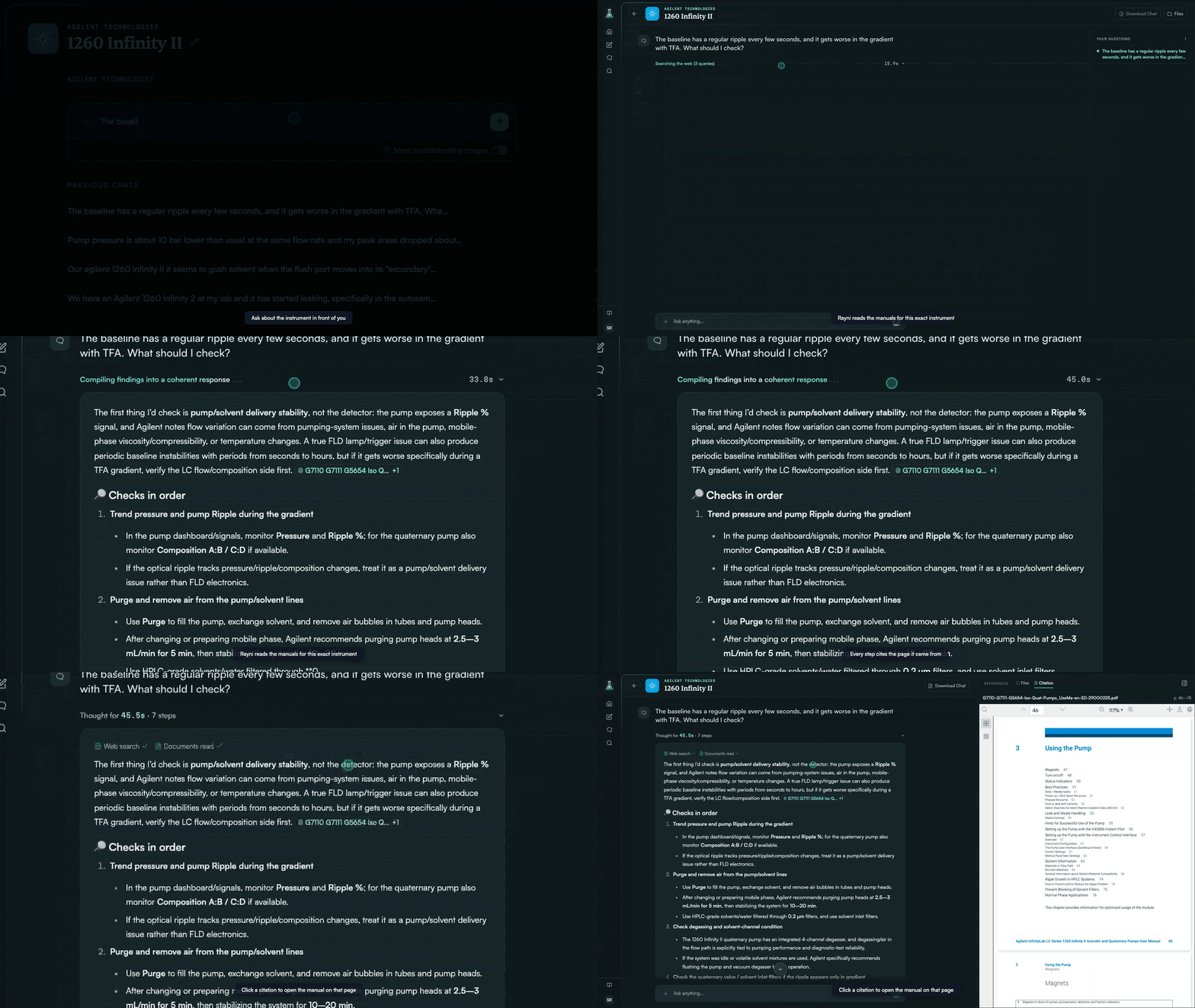
Figure 1. Recreated on a demo Agilent 1260 Infinity II from anonymized, aggregated user questions. Rayni checks the pump first and opens the cited chapter of the pump manual.
- The answer starts with the pump's pressure and ripple trace, because a ripple that matches it points to the pump and not the detector.
- Since the ripple grows in the gradient, it also checks the proportioning valve and the solvent compressibility setting.
- The purge and degassing steps come from the pump's user manual, and a click on the citation opens the pages they came from.
Why is the baseline still noisy with the flow off?
Then the fluid path is fine. Thermo Fisher's next step is to disconnect the detector's signal cables and short the inputs on the data system, which separates the detector from the computer that records it Reference [5]. If the noise stops, the fault is in the detector or its connections. If it continues, look at the data system Reference [5].
An aging lamp or dirty flow cell windows both cut the light that reaches the detector, and less light means more noise Reference [3]. Lamp warm up matters too. Shimadzu says to start measuring 1 to 1.5 hours after the lamp is turned on, because a lamp that has not settled causes drift Reference [1].
The lamp is not always the cause. Waters describes an energy test that runs 100% water and reads the sample and reference energy at 230 nm Reference [15]. It also lists a case where the reference energy reads higher than the sample energy on a lamp with only 300 hours, and it says the flow cell may be dirty Reference [15]. In that situation a new lamp is unlikely to help.
Sample can also coat the cell windows over time Reference [16]. For reversed phase systems, Agilent's flush takes the column out and runs water at 1 mL/min for an hour, then isopropanol for at least an hour, while keeping the pressure under 60 bar Reference [17]. Wavelength matters as well. Below 220 nm, noise rises on its own, and Taylor advises acetonitrile over methanol at those wavelengths Reference [3].
How Rayni helps
Operators often ask some form of: "The baseline noise is still there with the pump off. Is it time for a new lamp?"
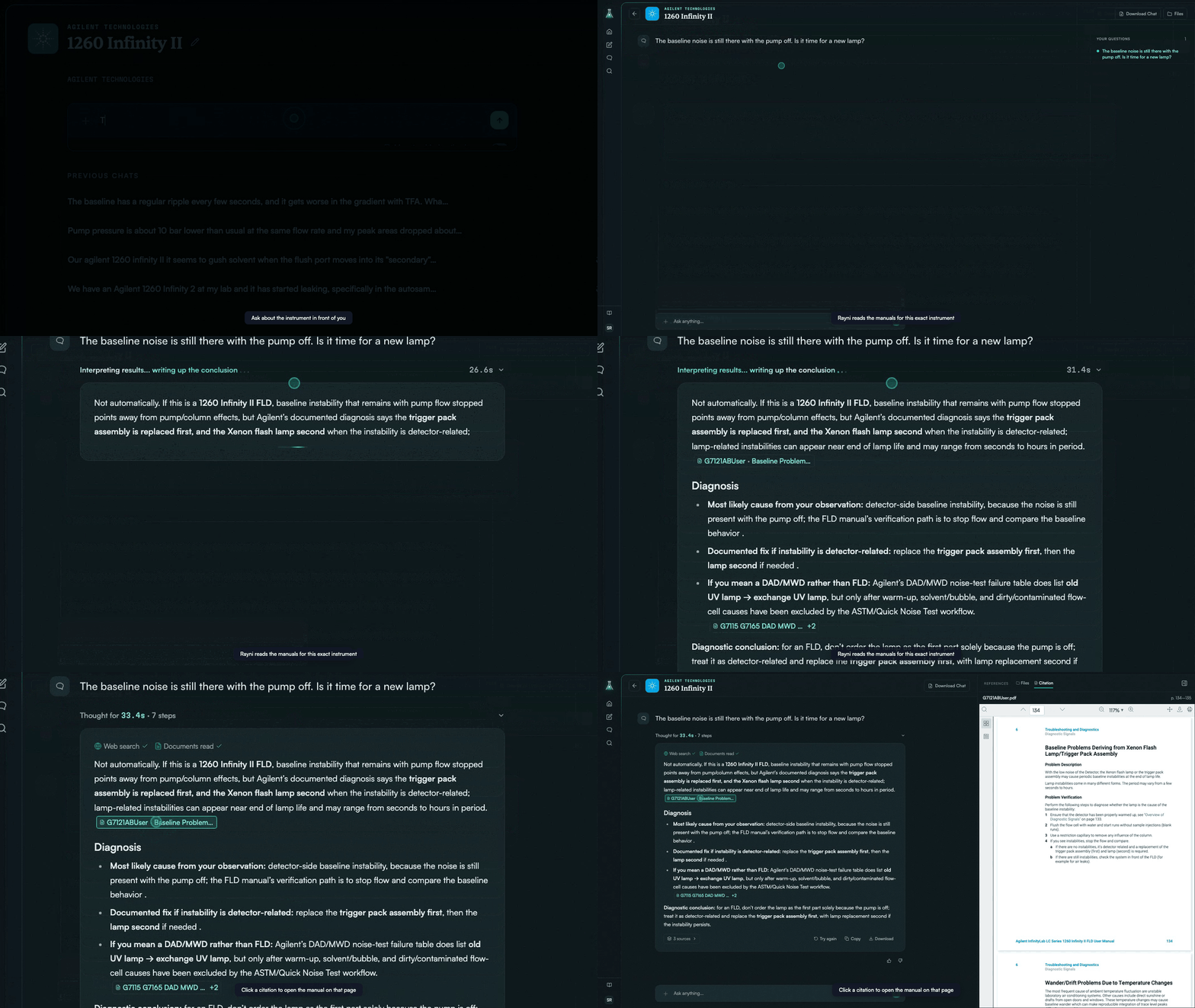
Figure 2. Recreated on a demo Agilent 1260 Infinity II from anonymized, aggregated user questions. The answer opens the detector manual on its baseline problems page.
- Rayni says not yet. For the 1260 Infinity II fluorescence detector, Agilent's manual replaces the trigger pack before the lamp when the noise comes from the detector.
- For a diode array detector, the answer lists what the noise test rules out before a lamp swap, such as warm up, bubbles and a dirty flow cell.
- The citation opens the detector manual on its baseline problems page, right beside the answer.
Why is my GC baseline noisy or climbing?
Start by separating the detector from everything upstream of it. Agilent's method is to blank off the detector, which means taking the column out and capping the fitting, after cooling the detector below 50 °C Reference [18]. Then run a blank injection. If you run hydrogen carrier, do not leave the open column venting into the oven Reference [18].
Agilent gives FID numbers to work with. A normal background with no sample and a cool oven is 5 to 20 pA, and contaminated gas usually pushes it above 20 pA Reference [9]. Turning off the makeup gas is a quick purity test, and a drop of more than 5 pA makes that gas suspect Reference [9]. A partly plugged or dirty jet makes the flame unstable. Agilent's steps include cleaning or replacing the jet, the collector and the PTFE insulators Reference [9]. Eric Denoyer of Agilent explains one way the jet plugs: column bleed burns in the flame and forms silicon dioxide on the tip Reference [19].
Gas supply is the next suspect. If the noise began with a new cylinder, Agilent says to change the cylinder and flush the gas lines Reference [10]. Its ECD guide adds that tanks should be changed before they run empty, because contamination can enter the gas lines when a tank is pulled too low Reference [20]. On an ECD, a baseline above 1000 Hz points to a leak Reference [20].
A baseline that rises with oven temperature often points to column bleed Reference [12]. Restek's test needs no sample. Hold the oven at one temperature, inject nothing and watch the baseline Reference [11]. Some bleed is normal, since every stationary phase breaks down slowly, but bleed that starts at a lower temperature than expected is a problem Reference [12]. Oxygen is the most likely cause of high bleed, so Restek recommends a leak check and inline oxygen filters Reference [12]. Even the smallest leak can damage the phase in minutes at high temperature Reference [11].
Separate peaks in a blank run tell a different story. Phenomenex says septum bleed shows up as peaks in blank injections, and its test is to raise the inlet temperature by 30 °C Reference [13]. If the peaks grow while the baseline stays the same, the septum is the source Reference [13]. Spikes need a closer look as well. In one of Taylor's GC examples, spikes with no peak shape came from a column sitting too high in the FID Reference [14].
How Rayni helps
A common version of this question: "The FID baseline has been noisy since we swapped the hydrogen cylinder on Monday. What should I check?"
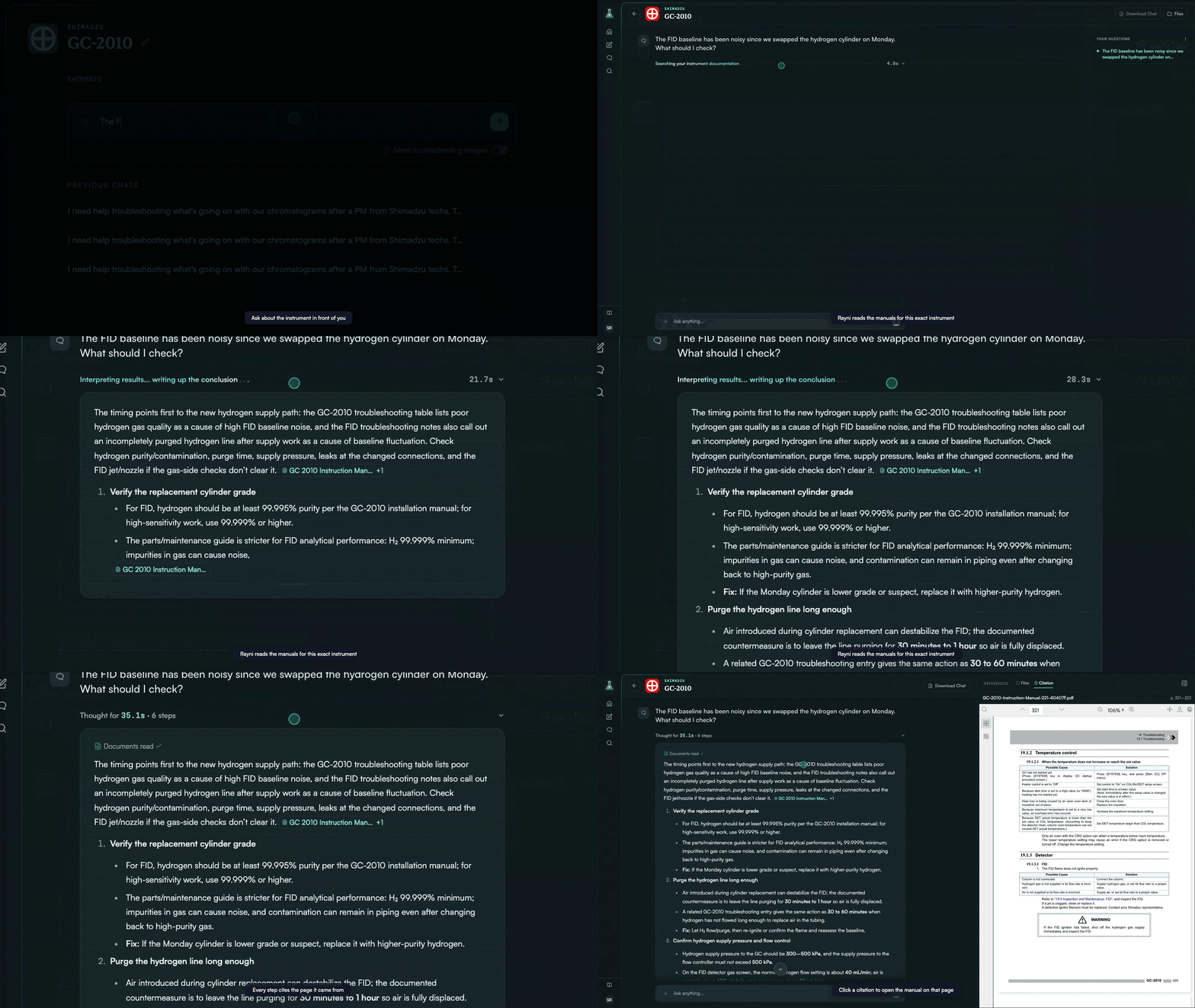
Figure 3. Recreated on a demo Shimadzu GC-2010 from anonymized, aggregated user questions. Rayni puts the gas checks from the GC-2010 manuals ahead of jet cleaning.
- Rayni starts from what changed. The new cylinder puts hydrogen purity and a full purge of the line ahead of jet cleaning.
- The purity grade, the 30 to 60 minute purge and the supply pressure all come from the GC-2010 manuals.
- A leak check on the fittings disturbed in the swap comes next. Jet cleaning waits until the gas checks pass.
Could the room be the problem?
Sometimes the instrument is fine. In one of Dolan's LCGC columns, a detector showed a sine wave with a period of about seven minutes, and the noise stayed even with the flow at zero Reference [21]. Extra ground wires, a different circuit, removing the UPS and swapping detector parts did not remove it. The noise disappeared when the system was wheeled to the far side of the room, and the owner chose to move it elsewhere rather than keep chasing the cause Reference [21].
RI detectors are sensitive to the room. Agilent lists air conditioning, sunlight, heaters and air currents as causes of failed RI noise and drift tests Reference [8]. Shimadzu notes that drift follows room temperature with some delay Reference [7]. On a GC, Denoyer says even opening and closing a door can put a large spike on a TCD Reference [19]. Thermo Fisher's advice is to keep the detector away from equipment that cycles on and off, such as large motors, and to make sure it is grounded Reference [5].
Have a baseline that will not settle? Ask Rayni about it at www.rayni.ai and check the manual page it cites.
References
All sources accessed October 27, 2026.
- Shimadzu Scientific Instruments. Troubleshooting Baseline Problems. Nexera Virtual Advisor, no date.
- John W. Dolan. Check Valve Problems. LCGC, February 1, 2006.
- Tony Taylor. The LCGC Blog: HPLC Diagnostic Skills, Noisy Baselines. LCGC, February 13, 2019.
- KNAUER. Optimize your HPLC-UV system for applications with TFA (VTN0032). KNAUER, February 2024.
- Thermo Fisher Scientific. Successful HPLC Operation: A Troubleshooting Guide (TG20421). Thermo Fisher Scientific, 2016.
- Shimadzu Scientific Instruments. Baseline Noise Caused by Bubbles Forming or Accumulating Inside Detector Cells. LCtalk Special Issue 5, no date.
- Shimadzu UK. HPLC Troubleshooting Course Part 3: Baseline Disturbances. Shimadzu, no date.
- Agilent Technologies. Troubleshooting a Failed ASTM Drift and Noise Test for the Agilent RID (KP239). Agilent Community LC Portal, updated October 20, 2024.
- Agilent Technologies. Troubleshooting FID Noise and High Background. Agilent Community GC Portal, updated August 1, 2023.
- Agilent Technologies. Excessive Background Noise in GC (KP532). Agilent Community GC Portal, updated June 28, 2024.
- Alan Sensue. Troubleshooting GC Column Baseline Issues. Restek ChromaBLOGraphy, January 5, 2021.
- Restek Corporation. GC Troubleshooting: High GC Column Bleed (video). Restek, January 3, 2018.
- Phenomenex. How to Minimize Septum Bleed Problem in GC. Phenomenex blog, no date.
- Tony Taylor. The LCGC Blog: GC Troubleshooting in 20 Pictures (Part 1). LCGC, November 17, 2015.
- Waters Corporation. Noisy baseline on UV detectors (WKB933). Waters Knowledge Base, no date.
- John W. Dolan. UV Detector Problems. LCGC, June 1, 2014.
- Agilent Technologies. How to Flush an HPLC Flow Cell to Troubleshoot Baseline Noise (KP457). Agilent Community LC Portal, updated October 20, 2024.
- Agilent Technologies. How to Blank off a GC Detector for Troubleshooting (KP867). Agilent Community GC Portal, updated August 17, 2023.
- Angelo DePalma. GC Troubleshooting: Tips for Quickly Returning to Normal Operation. Lab Manager, no date.
- Agilent Technologies. ECD Baseline Troubleshooting (KP213). Agilent Community GC Portal, updated August 1, 2023.
- John W. Dolan. The Bermuda Triangle. LCGC, April 1, 2005.