Rayni vs. General-Purpose AI: How AI Built Specifically for the Lab Beats Consumer-Grade AI
Scientific manuals aren't text documents. They're diagrams, schematics, and screenshots. Here's why general-purpose AI can't see the answers scientists actually need, and what we built instead.
When scientists ask questions about their instruments, they need accurate and trustworthy answers: the exact port, the specific button, the wiring diagram on page 47. The problem is that most AI tools were never built to find it.
Scientific instrument manuals are not text documents. They contain hardware diagrams, software screenshots, wiring schematics, troubleshooting flowcharts, and tables. The answers scientists actually need are almost always in those visuals.
The Data Accuracy Problem: What General AI Tools Cannot See
Tools like NotebookLM and ChatGPT use commodity PDF-parsing libraries. They extract readable text and skip everything else without flagging it. The AI fills the gap with plausible-sounding answers. This is not dramatic hallucination. It is confident answers to questions the AI never had the information to answer.
What gets skipped:
- Which port to plug into (hardware panel diagrams)
- Which button to click in the software (UI screenshots)
- What a healthy pressure curve looks like vs. a failing one
- How components are wired together (schematic diagrams)
- Step-by-step hardware assembly in photos
Same question. Same source document. Two very different answers.
NotebookLM: Ignores Figures
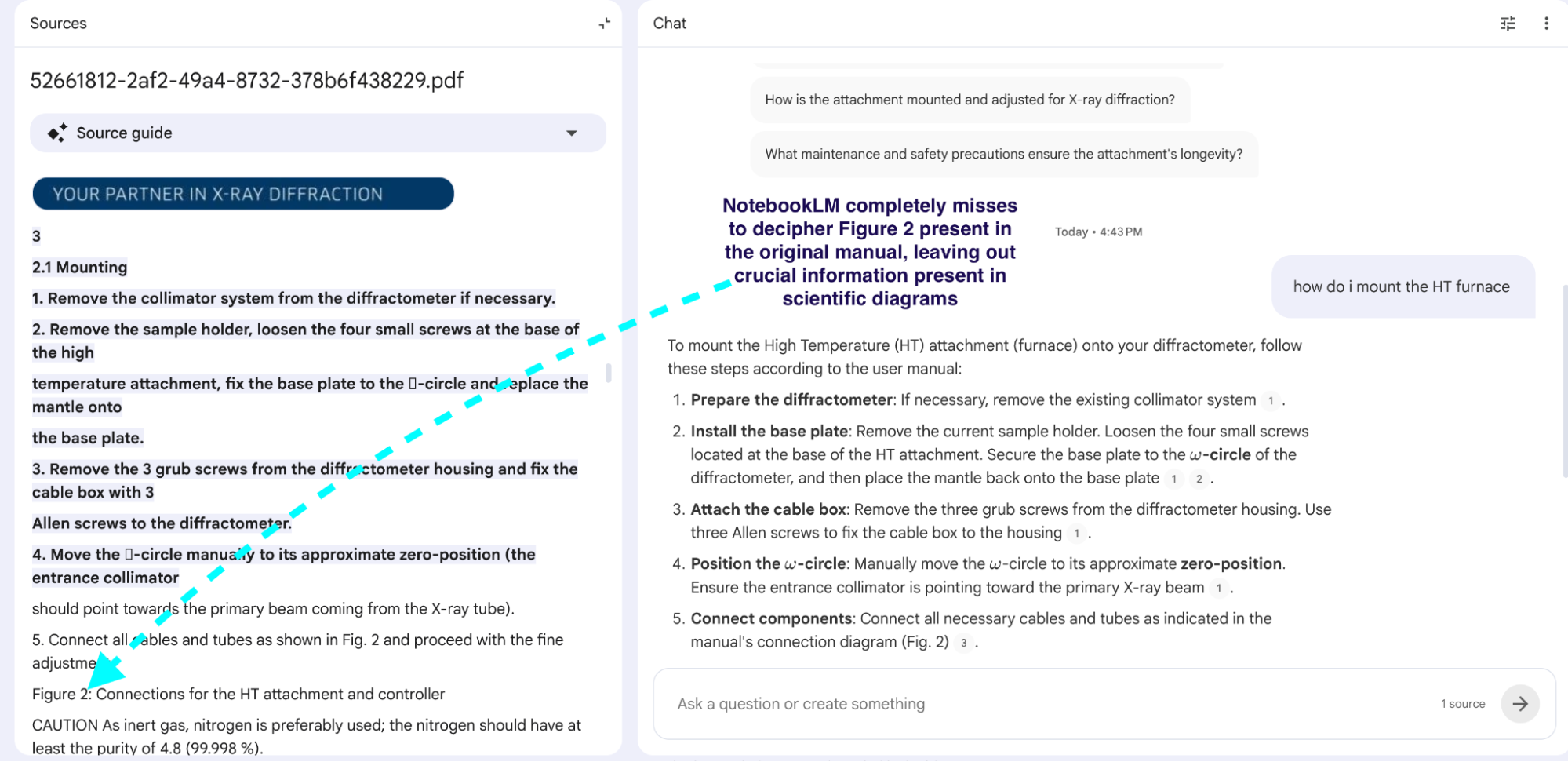
NotebookLM reads the text "connect all cables as shown in Fig. 2" but cannot process or display Figure 2. The wiring diagram containing the actual answer is missing.
Rayni: Reads and Displays Scientific Diagrams
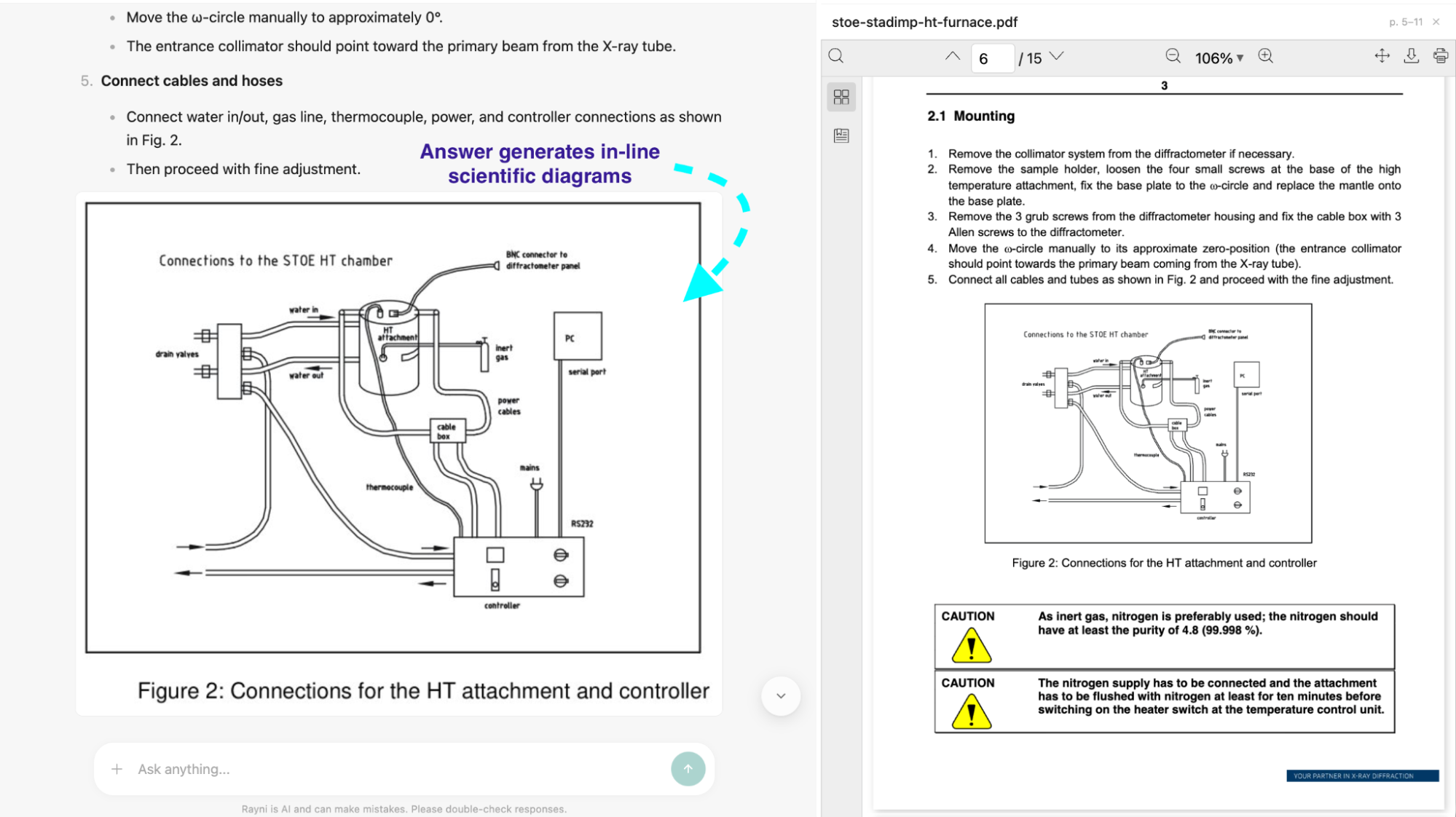
Rayni renders Figure 2 containing the full connection diagram for the HT furnace inline in the answer, and cites the exact section of the document.
Rayni built a dedicated ingestion pipeline that reads every piece of information in a manual, not just the text itself:
- Tables parsed with structure intact
- Hardware photos and panel diagrams understood in context
- Software UI screenshots interpreted so the AI can say which button to click
- Schematics processed so troubleshooting guidance reflects actual hardware layout
- Flowcharts followed as decision trees, not flattened into generic paragraphs
Rayni parses every document twice to make sure nothing is missed. That is expensive, dedicated engineering. Consumer AI skips it.
A Living Knowledge Tree, Not a Static Notebook
Consumer-grade AI treats every document as equally authoritative. Your lab's three-year-old SOP and the official manufacturer manual carry the same weight.
Rayni builds a structured knowledge tree and prioritizes your institution's own SOPs over manufacturer documentation. When they conflict, your knowledge wins.
Tools like NotebookLM are also snapshots. When something changes, someone has to remember to re-upload. Rayni's knowledge tree updates every day. Every interaction, every flagged gap feeds back in. The system gets smarter about your facility over time.
"Students graduate, employees leave, but the knowledge stays."
User Roles and Access Control: Built for Facility Safety
General-purpose AI tools have one mode: anyone with access can ask anything and get the full answer. In an institution with rotating users and varying skill levels, that is a real risk.
Rayni shows you the full decision-making path for every answer: which documents were consulted, what was prioritized, and what was ruled out. You see the AI's reasoning, not just its output.
Rayni has full user provisioning and role-based access:
- Training-gated access: Only users trained on a given instrument can query the AI about it.
- Tiered visibility: Sensitive procedures are restricted to experts. Non-experts get safe, scoped answers.
- Write protection: Only admins can add, modify, or delete instruments, SOPs, and knowledge.
- Safety as a design constraint: Rayni is built knowing its answers can have physical, irreversible consequences. Rayni will only show what users are authorized to see.
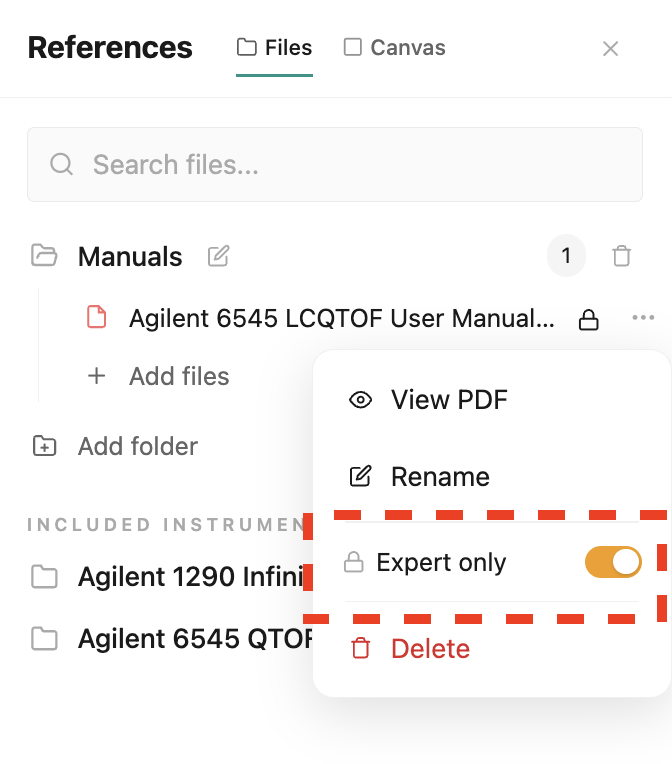
Rayni gives you granular control over who can access sensitive documents. Select any file and toggle Expert Only to restrict it to authorized users. Standard users only see what they are cleared for.
White-Glove Onboarding: You Hit the Ground Running
"Could we just do this ourselves with Claude or NotebookLM?" In practice, someone on your team spends days per instrument tracking down manual revisions, ingesting them, and correcting what commodity parsers missed.
Rayni handles all of it:
- Every instrument in your facility onboarded from day one
- Latest manual revisions ingested as manufacturers release them
- Roles and access configured for your team
- System kept current, with no AI operations burden on your staff
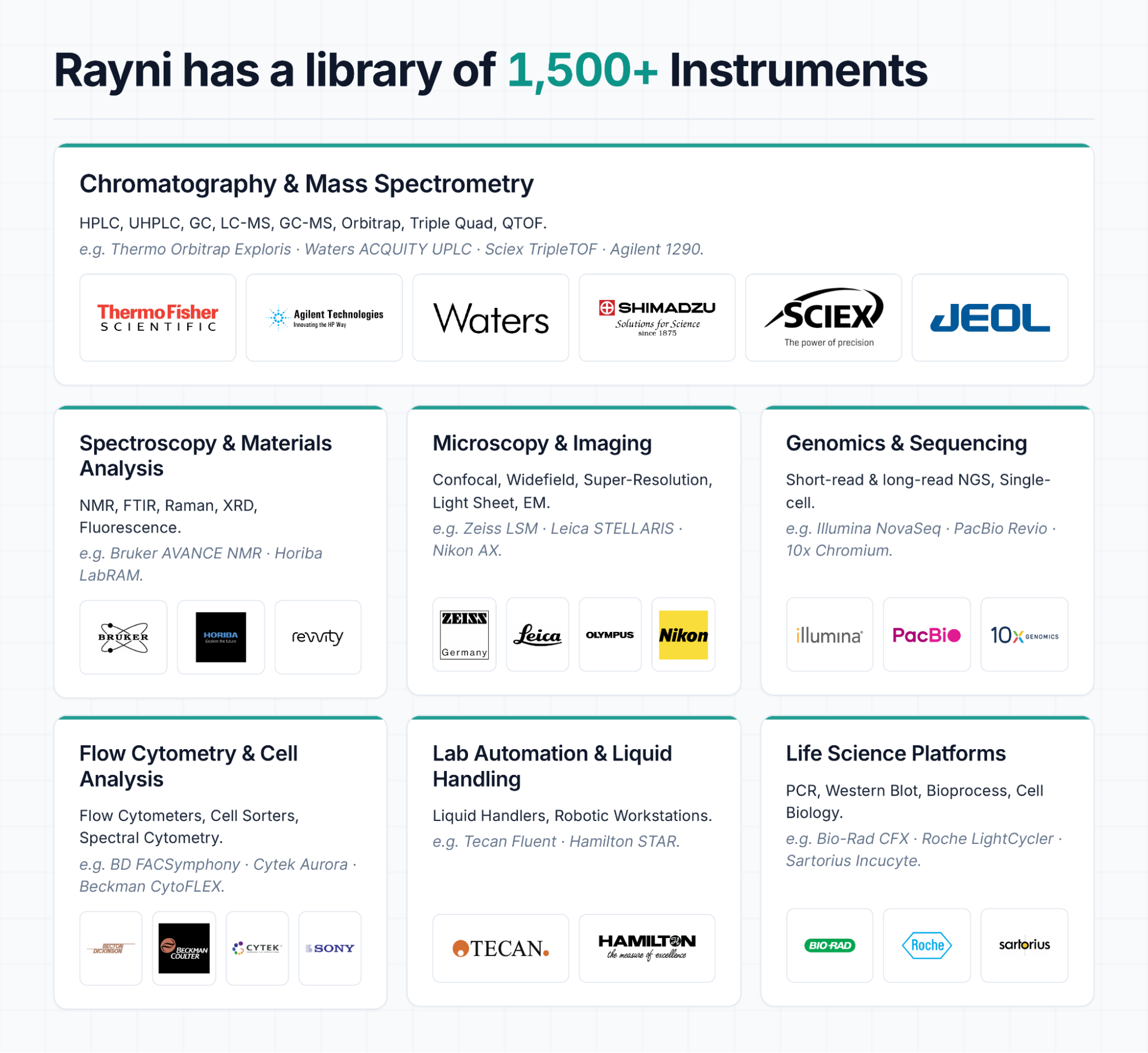
Rayni already has a built-in library of 1,500+ instruments from all major manufacturers across all scientific fields, from LC-MS to lab automation.
Different Roadmaps, Different Missions
Any general-purpose AI tool's roadmap is to serve as many people on the planet as possible. The stakes are low.
Rayni's roadmap goes deeper into scientific workflows every week:
- Working with manufacturers to add proprietary troubleshooting data
- Building toward pulling from instrument logs for operational diagnostics
- Adding scientific diagrams directly into responses
- Building step-by-step instructions that can be shared across the lab
ChatGPT and NotebookLM scale horizontally to everyone. Rayni specializes vertically into scientific experimentation and lab analysis.
This Is Not a ChatGPT Wrapper
Rayni runs a custom tech stack with multiple specialized models working in sequence:
- Retrieval model: Built to surface the right sections from large, dense instrument manuals
- Chunking model: Trained to split scientific content at meaningful boundaries rather than arbitrary character limits
- Scientific comprehension model: Trained on instrument documentation, error codes, fault trees, and calibration sequences
ChatGPT is one general-purpose model trained on the entire internet. Rayni is a pipeline of specialized models trained for one domain. Same chat interface. Completely different engine.
The Bottom Line
A general tool like Gemini or NotebookLM cites what it could read. Rayni reads everything in your manuals: text, tables, diagrams, screenshots. It builds a knowledge tree that puts your SOPs first, shows you how every answer was reasoned, and gates access by training and role.
If your team is asking questions about instruments, the answer is almost certainly in a diagram. Make sure your AI can see it.