One root problem, many symptoms: systematic chromatography troubleshooting
Retention shifts, broader late peaks, drifting peak areas and a rippling baseline can all come from the same place. Here is how to tell when flow or pressure is behind it, and the order to check things.
At a glance
| Symptom | Instrument | How flow or pressure can cause it | Check first |
|---|---|---|---|
| Late peaks come out later and broader during an oven ramp | GC | In constant-pressure mode, carrier gas gets more viscous as the oven heats, so column flow falls Reference [1] | Is the method set to constant pressure or constant flow? |
| Retention times stretch and peaks get shorter and broader once the oven starts ramping | GC | An inlet leak, such as an over-cored septum, can't hold head pressure as the ramp begins Reference [2] | Replace the septum and leak-check the inlet |
| Every peak shifts by the same proportion, including the dead time | HPLC | A flow change or a leak moves the dead time and every retention time together Reference [3] | Compare the dead time with normal, then time a flow collection |
| UV peak areas drift between runs | HPLC | With UV detection, peak area goes up as flow goes down Reference [4] | Confirm the pump delivers the set flow |
| A regular ripple in the baseline | HPLC | A systematic pattern points to the pump or a piston; mixing problems show up as baseline waves Reference [5] Reference [6] | Watch the pressure trace for cycling |
| Pressure cycles with each pump stroke | HPLC | Air in the pump or a faulty check valve Reference [7] | Purge the pump, then clean or replace the check valves |
| All peaks tail | GC | Usually a physical problem in the flow path, such as column installation Reference [8] | Re-cut and reinstall the column |
| Only some peaks tail | GC | Not flow: polar compounds sticking to active sites, often a dirty liner Reference [8] | Replace the liner |
When a chromatogram looks wrong, the instinct is to fix the symptom in front of you. But several symptoms that look unrelated often share one cause: the flow or pressure inside the instrument isn't what you think it is. Pressure, flow and leak problems come up in nearly 1 in 10 conversations on Rayni, across both GC and HPLC.
The good news is that flow problems leave fingerprints. If you know what they look like, you can trace a strange result back to its source in a few steps instead of replacing parts at random.
GC: the flow you don't see changing
Let's look at what type of question experts face every day. Here is a question a viewer sent to Dr. Lee Polite, president and founder of Axion Analytical Labs and an ACS certified chromatography instructor Reference [9]: "What could be wrong if my inlet total flow falls when the oven temp is ramping up?" Reference [10]
His answer: nothing is broken. It's the flow control mode. In constant-pressure mode, the GC holds the pressure at the head of the column fixed. As the oven heats, the carrier gas gets more viscous, so the same pressure pushes less gas through the column Reference [1] Reference [11]. Dr. Lee compares it to sipping honey through a straw instead of water.
The drop can be large. In one LCGC example, flow through a wide-bore column fell from 6.5 to 4.3 mL/min as the oven went from 50 to 250 °C Reference [1]. That slowdown shows up in several places at once:
- Late peaks come out later. In the same example, the last peak eluted at 24.85 minutes in constant pressure and 22.79 minutes in constant flow Reference [1].
- Runs get longer, and constant flow helps keep late peaks sharp and narrow Reference [12].
- The total flow reading can dip. Dr. Lee notes this is usually a small change, easiest to see with wide-bore columns or low split ratios Reference [10].
The fix is a setting, not a part: switch the method to constant flow. As Dr. Lee puts it, "Constant flow will always give you the best results" Reference [10].
A real leak can look similar. Restek describes an over-cored septum that couldn't hold head pressure once the oven ramp began. Retention times stretched and peaks came out shorter and broader Reference [2]. If switching to constant flow doesn't fix it, replace the septum and leak-check again.
How Rayni finds the root cause. Ask Rayni the same question about a GC-2010 and it starts where Dr. Lee did: the flow control mode. It checks whether the method runs in pressure control, points you to constant linear velocity mode, and links the flow control section of the GC-2010 manual. Only then does it move on to supply pressure, leaks and the septum (Figure 1).
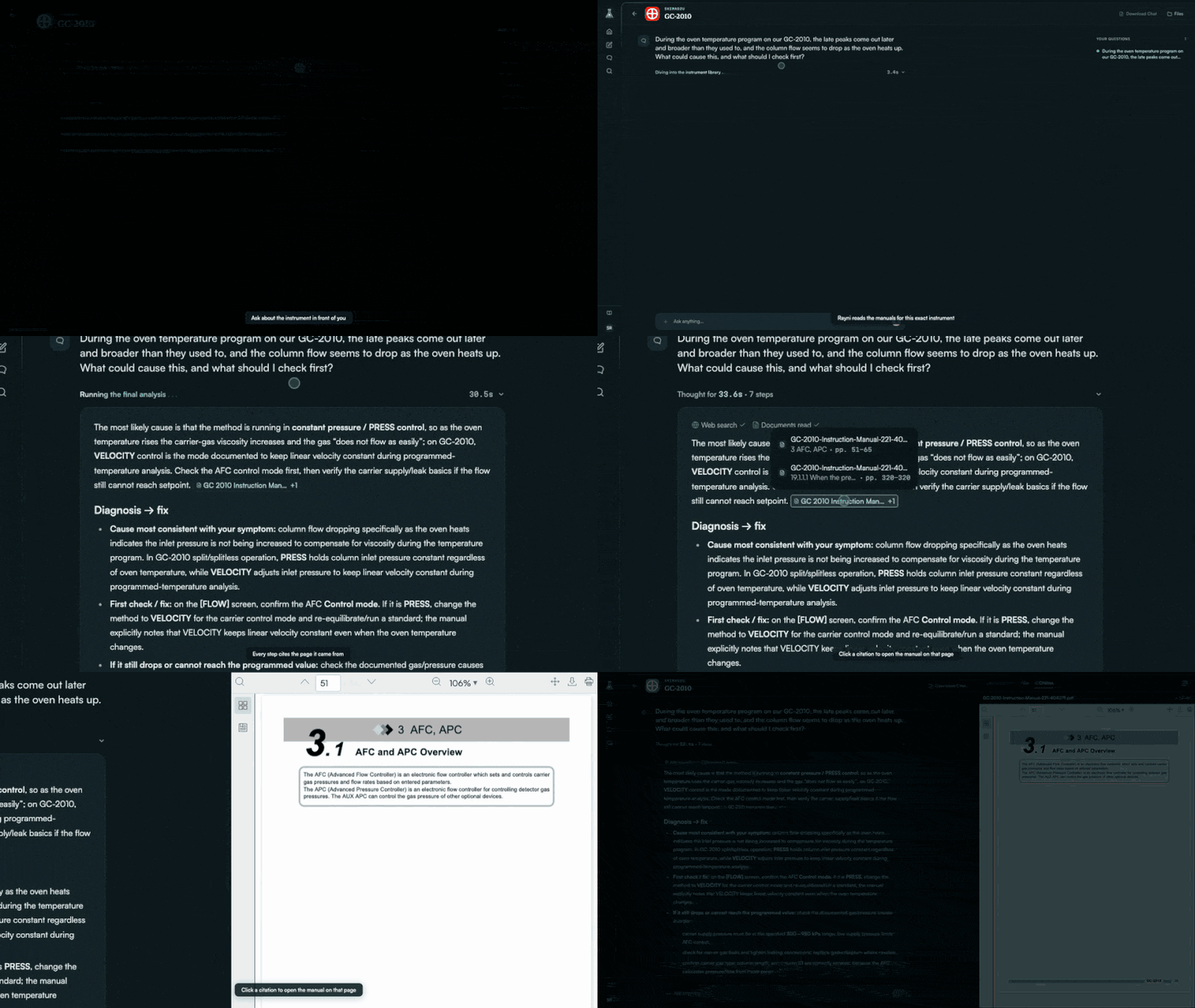
Figure 1. Rayni demo on a GC-2010. Demo questions are simplified from anonymized, aggregated usage data and recorded in a Rayni demo account.
HPLC: when the pump can't keep up
In HPLC, the pump sets the flow, and the flow sets almost everything downstream. One weak pump part can show up as several different symptoms:
- Retention times shift. Retention is inversely related to flow Reference [13]. A useful test: if the dead time moved by the same proportion as your peaks, the flow changed. A leak does this too Reference [3].
- Peak areas drift. With UV detection, peak area rises as flow falls, so a flow error changes the amounts you calculate Reference [4].
- The baseline ripples. A regular pattern points to the pump or a piston Reference [5]. Mixing and proportioning problems show up as baseline waves Reference [6].
- The pressure cycles in step with the piston stroke, which usually means air in the pump or a faulty check valve Reference [7].
The usual culprits are the same few parts. Low flow comes from faulty check valves, worn pump seals or air bubbles Reference [3]. Check valves are a common weak point: a single fiber of dust is enough to make one leak Reference [14]. A leak can lower system pressure, but a small one may not show on the gauge at all Reference [3].
The fastest way to settle it is to measure. Collect 10 mL from the outlet into a volumetric flask and time it. The result should be within 1% of the set flow Reference [7].
How Rayni finds the root cause. Ask Rayni about drifting retention times and a rhythmic baseline on a 1260 Infinity II and it starts with the pump: check the pressure and ripple readout, purge air from the pump heads, then run the system pressure test, with each step linked to the page in Agilent's pump manual (Figure 2).
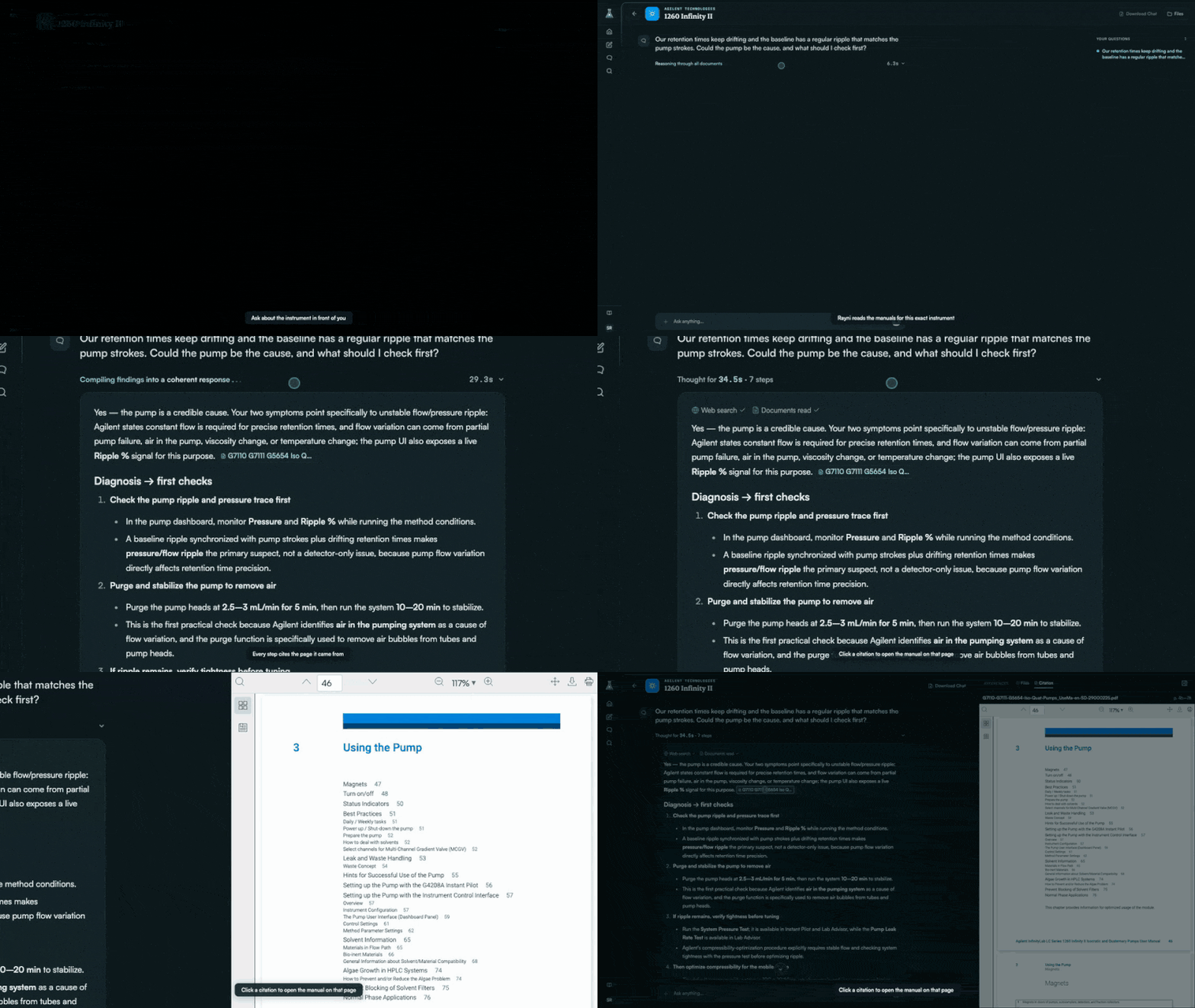
Figure 2. Rayni demo on a 1260 Infinity II pump. Demo questions are simplified from anonymized, aggregated usage data and recorded in a Rayni demo account.
Same symptom, different cause
Not every odd peak is a flow problem, and that is exactly why the order of checks matters. Tailing is a good example.
While filming a method development series, Dr. Polite saw some peaks tailing while others looked fine Reference [15]. When every peak tails, the cause is usually physical, in the flow path or column installation Reference [8] Reference [16]. When only some tail, especially polar compounds like alcohols, the compounds are sticking to active sites, often in a dirty liner Reference [8].
So, Dr. Lee replaced the liner. The alcohol peaks went from symmetries in the low 0.4s to 0.84 and 0.89, where 1.0 is a perfect peak Reference [15]. His follow-up advice is to also replace the inlet seal and trim a little off the front of the column, the same steps Restek recommends Reference [16].
A systematic order of checks
- Pin down what changed. Compare pressure, retention times and, in HPLC, the dead time against a known good run Reference [7].
- Check the settings. Flow rate, the GC flow control mode, the installed column and the method you actually loaded.
- Look for leaks. In GC, start with the septum. In HPLC, walk the flow path from the bottles to the detector.
- Measure the real flow. In HPLC, time a 10 mL collection Reference [7].
- Replace the cheap parts. GC: septum, liner and inlet seal, then trim the column Reference [16]. HPLC: purge, clean or replace the check valves, then the pump seals Reference [7].
- Only then look at the column chemistry or the detector.
How Rayni helps
- One place for GC and HPLC, across every vendor you run, so the same question works on any instrument.
- Answers from your instrument's own manuals, with every step linked to the exact page, as in the demos above.
- Expert video built in. Rayni can answer from expert training videos like Dr. Lee's and take you to the moment in the video that matters.
- Your own notes count. Add your SOPs and past fixes, so what your team learns from one breakdown is there for the next.
Want to see how Rayni handles your instruments? Pick two of your trickiest recent problems and try them at www.rayni.ai.
References
- Hinshaw JV. Using computerized pneumatics, part II. LCGC (GC Connections), January 2008. https://www.chromatographyonline.com/view/using-computerized-pneumatics-part-ii
- Hilliard C. Just because you don't have a leak does not mean you don't have a leak. Restek, October 4, 2022. https://discover.restek.com/?p=51732
- Dolan JW. Troubleshooting basics, part 3: retention problems. LCGC, December 2011. https://www.chromatographyonline.com/view/troubleshooting-basics-part-3-retention-problems
- Stoll DR. Effects of flow rate on UV detection in liquid chromatography. LCGC, December 2019. https://www.chromatographyonline.com/view/effects-flow-rate-uv-detection-liquid-chromatography
- Restek. LC troubleshooting: baseline problems (video). January 3, 2018. https://discover.restek.com/videos/gnav3620/lc-troubleshooting-baseline-problems
- Stoll DR. Surfing on mobile phase, part 1: origins of mobile-phase composition waves and their effects on detector baselines. LCGC, February 2021. https://www.chromatographyonline.com/view/surfing-on-mobile-phase-part-1-origins-of-mobile-phase-composition-waves-and-their-effects-on-detector-baselines
- Dolan JW. Troubleshooting basics, part II: pressure problems. LCGC North America, September 2011. https://www.chromatographyonline.com/view/troubleshooting-basics-part-ii-pressure-problems
- Taylor T. The LCGC blog: GC diagnostic skills I, peak tailing. LCGC, March 10, 2020. https://www.chromatographyonline.com/view/lcgc-blog-gc-diagnostic-skills-i-peak-tailing
- Axion Analytical Labs. Our team. https://axionlabs.com/team/
- Polite L. GC troubleshooting: why total flow drops during temperature ramps (video). Axion Labs & Training Institute, December 8, 2025. https://www.youtube.com/watch?v=X05Rvi-5hrU
- Phenomenex. Constant pressure or constant flow? GC tech tip. https://discover.phenomenex.com/constant-pressure-constant-flow-gc-tip-en-0326
- Rattray C. Revisiting the optimal heating rate for gas chromatography. Restek, August 4, 2022. https://discover.restek.com/blogs/gnbl5530/revisiting-the-optimal-heating-rate-for-gas-chromatography
- Dolan JW. Retention time drift: a case study. LCGC, April 21, 2016. https://chromatographyonline.com/view/retention-time-drift-case-study-0
- Dolan JW. Check valve problems. LCGC North America, February 2006. https://www.chromatographyonline.com/view/check-valve-problems-1
- Polite L. Demystifying GC method development: troubleshooting tailing peaks (video). Axion Labs & Training Institute, February 17, 2026. https://www.youtube.com/watch?v=e3KlFNK7qBw
- Restek. GC troubleshooting: tailing peaks (video). January 14, 2018. https://discover.restek.com/videos/gnav3602/gc-troubleshooting-tailing-peaks